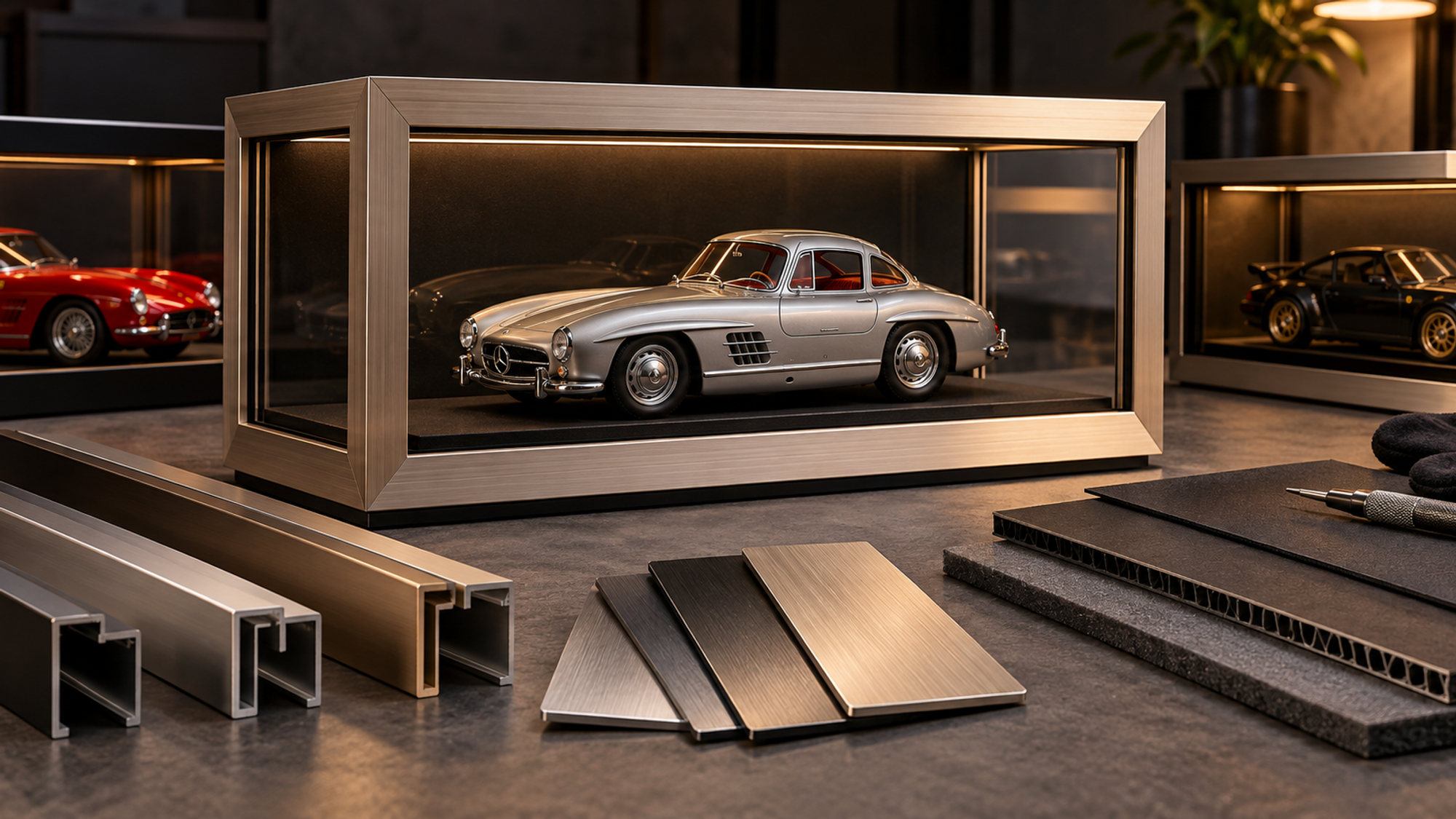
Two frames can look identical in a photograph and feel like different price categories the moment you pick them up.
That difference is not shape, and it is usually not thickness. It is a set of decisions about alloy, finish chemistry, and the panel behind the metal — none of which photograph, all of which determine whether the object still looks right in ten years.
This is how to evaluate any display frame, including ours. There are four tests at the end you can run in about ninety seconds.
Alloy, and what "aerospace-grade" actually means
Aluminium is not one material. It is a family of alloys with very different properties depending on what has been added to it.
For extruded architectural and product sections, the 6000 series is the standard answer — aluminium with magnesium and silicon. It extrudes cleanly, holds a sharp corner, machines predictably, welds acceptably, and anodises well. That last property is the one that matters most here and it is not universal: some alloys anodise to an uneven, cloudy finish, which is why you cannot simply pick the strongest option. [VERIFY: state the specific alloy and temper you use.]
"Aerospace-grade" is a phrase doing two jobs. There genuinely are aluminium alloys specified for aerospace use — typically 2000 and 7000 series, alloyed with copper or zinc, considerably stronger. They are also more expensive, harder to extrude into thin decorative sections, and in some cases significantly less corrosion-resistant than the 6000 series.
So when a display frame is described as aerospace-grade, one of two things is true: it is a genuine high-strength alloy, in which case the maker has chosen strength the application does not need at the cost of properties it does; or the phrase is being used loosely to mean good aluminium.
Neither is dishonest, exactly. But for a frame, the honest specification is "the right alloy for an extruded, anodised section under modest sustained load", and that is the 6000 series. Strength is not the binding constraint here. Finish quality and dimensional stability are.
Anodising versus painting versus powder coating
This is the single biggest determinant of how a frame ages, and it is invisible in every product photograph.
Paint sits on top of the metal. It is a separate layer with a mechanical and chemical bond to the surface. Bonds fail. Paint chips, and it chips first at edges and corners — which on a frame are exactly the places your hand contacts when you lift it off the wall.
Powder coating is a thicker, tougher applied layer, electrostatically deposited and baked. Better than wet paint by a wide margin. Still a layer on top of the substrate, still capable of chipping, and thick enough that it softens fine detail and rounds off crisp arrises slightly.
Anodising is not a coating. It is a controlled electrochemical conversion of the aluminium's own surface into a hard, porous oxide layer, which is then sealed. The finish is not on the metal — it is the metal, chemically altered to a depth of some tens of microns.
The practical consequences:
- It cannot chip, because there is no interface to fail at. It can be scratched or abraded, but it does not flake.
- It does not add thickness in a way that blunts detail. Extruded edges stay sharp.
- It is dimensionally stable and does not soften with heat.
- It is chemically vulnerable to strong alkalis and acids — which is why cleaning matters, and why glass cleaner is a genuinely bad idea on a frame.
The catch is colour range. Anodising is a dyeing process into a porous oxide layer, which gives a narrower and more muted palette than paint. Deep saturated colours are hard, and consistency between production batches requires real process control. A frame maker who anodises has accepted a harder manufacturing problem in exchange for a finish that lasts. [VERIFY: state your anodising specification — Type II is the usual architectural standard; confirm before publishing.]
Finish direction: brushed, blasted, mirror
Same metal, same anodising, entirely different objects.
Brushed has a directional grain from mechanical abrasion before anodising. Under a downlight it produces a soft directional sheen that shifts as you move. It hides fingerprints and light surface marks better than any other finish, because the existing grain camouflages them. For an object mounted on a wall in domestic light, it is the most forgiving choice.
Bead-blasted is uniform and matte, with a fine even texture. Very calm, very consistent under any lighting, no directional sheen at all. It shows fingerprints more than brushed, because there is no grain to hide them in.
Mirror-polished is dramatic, difficult, and a poor choice here. It reflects the room back at you, shows every fingerprint and every micro-scratch, and competes visually with the object it is presenting.
For a frame whose job is to disappear behind the model, brushed or blasted. Anything more reflective is the frame asking for attention.
The panel nobody asks about
Here is the part that actually fails.
Behind the metal is a backing panel. It carries the artwork, provides the plane the model sits against, and gives the assembly its stiffness. And in cheap frames it is standard MDF.
Standard MDF is hygroscopic — it absorbs atmospheric moisture. It does so unevenly, because one face is usually printed or sealed and the other is not, so the two faces take up water at different rates. Differential expansion across the thickness produces a bow.
In a frame, a bowed panel pushes the centre of the display outward, the model stops sitting flat, and the whole assembly develops a subtle wrongness that is very hard to diagnose and impossible to fix. It typically takes one to three years in a humid climate.
If you live in Hong Kong, Singapore, coastal Australia, the American South, or anywhere with a real summer, this is not theoretical. It is the most common way a display frame dies, and it is completely invisible at the point of purchase.
High-density fibreboard with a sealed reverse face is the answer. It costs more, weighs more, and is one of the least glamorous line items in a bill of materials. [VERIFY: confirm your panel specification and thickness.]
Print and colour
Backing artwork is printed, and livery colours are one of the harder colour problems in product manufacturing.
A team colour exists in at least three incompatible forms: the physical paint specification on the car, the sRGB value used in broadcast and web graphics — chosen to look correct on a backlit screen — and whatever the printing process can physically achieve on the substrate.
These do not reconcile, and no amount of care makes them. The screen value will always be more luminous than any printed equivalent, because one is emitting light and the other is reflecting it.
The right approach is to match to physical reference and accept that photographs will always be a slight lie. [VERIFY: state your printing process and pass count — multi-pass printing is a genuine quality differentiator and worth naming specifically.]
Hardware, and a failure mode people forget
The fasteners and wall fixings are not an afterthought.
Galvanic corrosion occurs when two dissimilar metals are in electrical contact in the presence of moisture. A steel fastener in an aluminium section is exactly this arrangement. In a dry interior it is slow. In a humid coastal environment, over years, it produces corrosion at the interface — and the failure is at the joint, which is the one place you cannot see it.
Stainless fasteners, or aluminium fasteners, or an isolating washer. It is a small cost and it is the difference between hardware that lasts and hardware that seizes. [VERIFY: confirm fastener specification.]
Load rating should be a real number derived from the wall fixing, not a marketing claim. A frame's rating is meaningless without stating the wall type it applies to — the same fixing behaves entirely differently in plasterboard and in concrete.
Four tests, ninety seconds
You can run these on any frame, in a shop or when yours arrives.
1. The edge test. Run a fingernail along an outer edge. Anodised aluminium feels crisp and slightly sharp; the finish is continuous with the metal. Painted or powder-coated metal feels marginally soft and rounded, and under a strong light you can often see the coating's thickness at the corner.
2. The flex test. Hold the frame by one corner and apply gentle twisting pressure. A well-specified section resists. If you can feel it wind, it will not sit flat against a real wall — and no wall is flat.
3. Weight to size. Aluminium has a specific density. A frame that feels surprisingly light for its size is either very thin section or not aluminium. Neither is what you paid for.
4. Corner joint inspection. Look closely at where the sections meet. A mitred, mechanically fixed corner with a tight line is a manufacturing decision. A visible gap, a smear of filler, or a moulded plastic corner piece tells you where the budget went.
**The reasoning applied to a specific object: **Inside the Ferrari SF-24 Display Frame
**Why the finish matters for maintenance: **Dust, UV and Fingerprints
**Why we make them repairable at all: **The Repairable Object