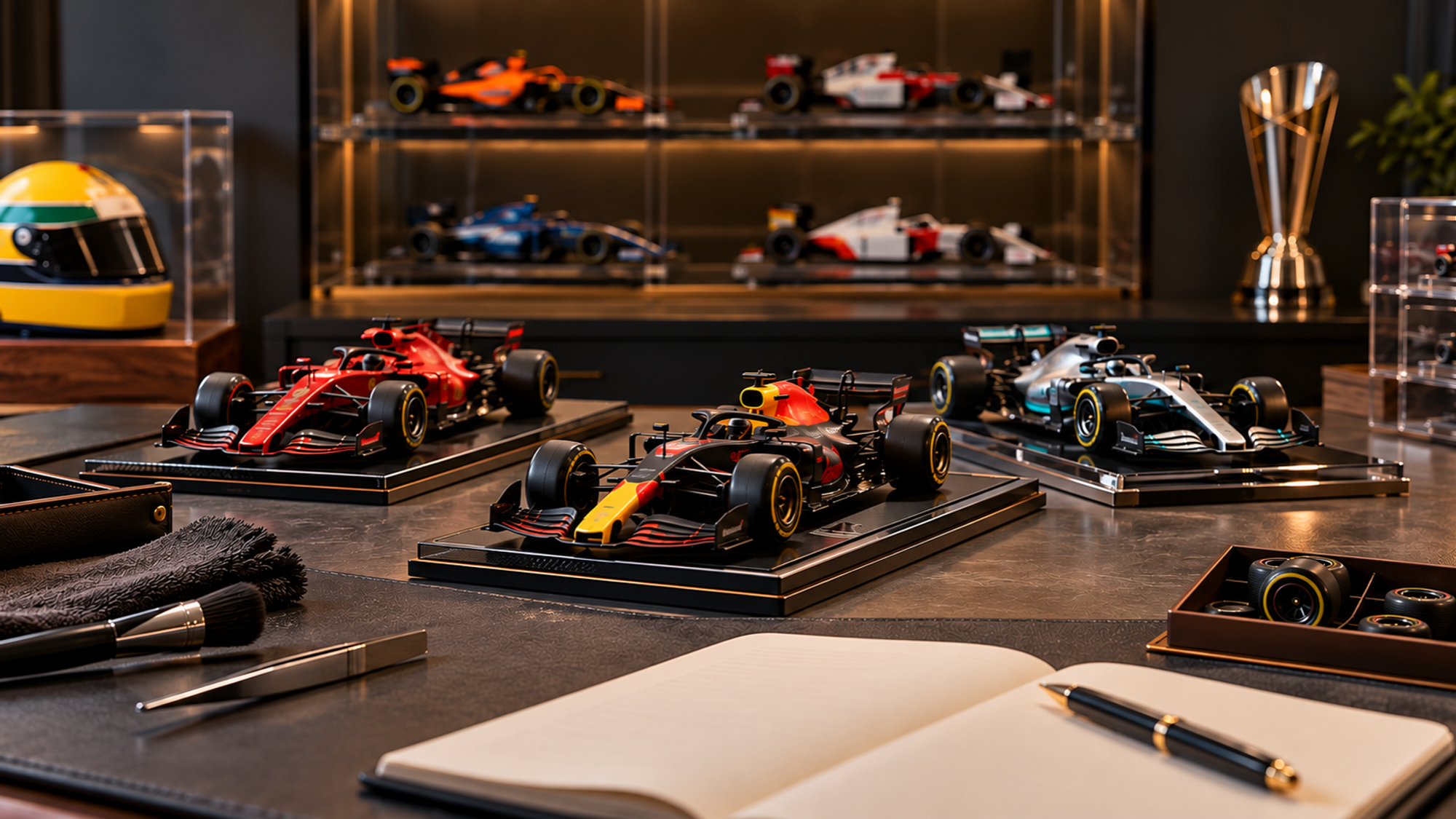
Most first collections are five unrelated objects bought in five unrelated moods. A cap from a race weekend. A 1:43 model of a car someone liked. A poster. A keyring. A second model, at a different scale, because it was reduced.
There is nothing wrong with any of those purchases individually. The problem is that they do not add up to anything, and the sixth purchase will not either unless something changes.
This is a framework for making the sixth one on purpose.
Start with a thesis, not an object
The single most useful thing you can do before spending any money is decide what your collection is about.
Not "Formula 1". That is a subject, not a thesis. Something narrower and arguable:
- One team across an era — Williams 1990–1997, say.
- One driver's full career, in one scale.
- One designer's work.
- One regulation period — the ground-effect years, the V10 era, the hybrid era.
- One machine, in depth: the car, the models, the era's rivals for context.
- One idea — cars that were banned, cars that never won, championship-deciding machines.
Two reasons this matters, one aesthetic and one practical.
Aesthetically, a collection with a thesis is legible to anyone who looks at it, including you. It tells a story on a shelf. A random assortment reads as accumulation, and accumulation is not interesting to look at.
Practically, a thesis makes decisions for you. When something comes up for sale, you are not asking "do I like this?" — you are asking "does this belong?" That question is answerable, and it will save you a great deal of money on things you liked for an afternoon.
You are allowed to change the thesis later. Most people do. But collect without one and you will end up with a shelf that could belong to anybody.
The four categories, honestly described
Race-used and authenticated material. Genuine parts, race-worn equipment, signed items with verifiable provenance. The most expensive category and the only one with a real secondary market at the top end. Also the category with the most fraud in it. Never buy authentication that comes from the seller — it needs to come from a party with a reputation to lose.
Licensed scale models. The core of most serious collections. Wide range of quality and price. Value holds best on limited numbered runs from established manufacturers; it holds worst on unnumbered mass-market pieces.
Fan merchandise. Caps, shirts, mugs, printed prints. Buy it because you want to use it. It will not hold value, and that is fine — most things people enjoy do not.
Display and presentation. Frames, cases, shelving, lighting. Not a collectible category, but the one that determines whether everything above is enjoyable to own. More on this below, because it is the line everyone leaves out.
We sell in the second and fourth categories. We do not sell in the first, and we would not, because doing authentication properly is a specialism and doing it badly is harmful.
What tends to hold value, and what does not
Tends to hold:
- Limited numbered runs from manufacturers with a track record. The number is doing the work, not the packaging.
- First-year liveries. A team's debut season, or the first appearance of a new identity. There is only ever one of those.
- Championship-decisive machines. The specific car and specific race that settled a title.
- Discontinued tooling. When a manufacturer retires a mould, the supply is fixed permanently.
- Regulation-boundary cars. The last of an era and the first of the next — see our piece on the 2026 reset.
Tends not to hold:
- Unnumbered mass merchandise, however well made.
- Anything with a printed or facsimile signature. If the signature is part of the print run, it is decoration.
- Autographs without third-party authentication. Assume unverifiable means worthless.
- Anything bought primarily because someone described it as an investment.
That last point deserves to be said plainly: most collectibles are not investments. A small number appreciate, a larger number hold roughly flat in real terms, and most decline. Buy things you want to look at. If one of them appreciates, treat it as a pleasant accident.
Budget tiers: what good looks like
[VERIFY: check these bands against current market rates before publishing.]
Under $100. One good 1:43 model of a car that matters to your thesis, properly displayed. Or a well-made functional object you will use daily — our DRS keyholders sit at $69.49 and are, deliberately, in this band. Avoid the temptation to buy three cheap things instead of one good one; this is where collections go wrong earliest.
$100–300. A collector-grade 1:18 model, or three to four considered 1:43 pieces, or one 1:18 plus the display for it. This is the band where the quality step is most visible — the difference between a $60 and a $200 1:18 model is not subtle.
$300–1,000. Serious territory. A premium 1:18 diecast with opening parts — our Almost Real RUF models are $249 and representative of this band's entry — plus proper display, plus room to add. Or the beginning of a genuine themed set at 1:43.
Above $1,000. You are now in a market with dealers, auctions and provenance questions. Slow down, talk to people who have been doing it longer, and buy fewer things.
The five mistakes almost everyone makes
1. Buying on team loyalty alone. Supporting a team is a reason to watch races. It is a thin organising principle for a collection, because it forces you to acquire mediocre seasons alongside great ones. The best team-based collections have a second filter — an era, a driver, a designer.
2. Ignoring the display cost until it is too late. Covered below. It is the most expensive oversight in the hobby.
3. Chasing sealed boxes you will never open. There is a real market in sealed collectibles, but it is a market for people trading, not for people looking. If you are never going to open it, you have bought a financial instrument with a shelf-life, not an object.
4. Buying unverifiable autographs. The economics of forgery are excellent and the economics of verification are poor. Assume the worst unless a reputable third party says otherwise.
5. Buying breadth before depth. Twenty mediocre pieces are worth less — financially and to look at — than five excellent ones. Depth first. Breadth arrives on its own.
The line nobody includes: display is a third of the cost
Budget 20–30% of your total spend on presentation, from the first purchase.
This sounds like an upsell coming from us, so consider the argument on its own terms. An unlit model on a crowded shelf at the wrong height is not being seen. You have paid for detail you cannot look at, in a scale chosen for close viewing, positioned where close viewing is impossible. The marginal pound spent on lighting and positioning does more for your enjoyment than the marginal pound spent on the next model — up to a point, and most collectors never get near that point.
Practically: decide your scale before you buy — our scale guide covers the space arithmetic — and know where the object is going before it arrives.
Where to buy in 2026
Official team and manufacturer channels. Safest, rarely cheapest, and the only reliable source for current-season licensed material.
Specialist dealers. The best source for anything older or unusual. A good dealer's knowledge is worth the margin. Red flag: vague provenance language, "believed to be", photographs that avoid the detail you asked about.
Auction houses. Where serious material moves. Read the terms — buyer's premium is typically substantial and catches first-timers out. Condition reports are written carefully; learn to read what they do not say.
Secondary marketplaces. Genuine bargains and genuine fakes in the same search results. Buy from established sellers with long histories, insist on photographs of the actual item rather than stock images, and treat any price well below market as information rather than luck.
Red flag across all channels: urgency. Legitimate sellers of collectible objects are not in a hurry.
A worked example: $600, with a thesis
Say the thesis is the 2026 regulation reset — the first season of a new formula, which will be a defined historical boundary whether the racing is good or not.
- A 1:43 model of a 2026 car in its debut livery — first-year livery, single season, permanently finite. [VERIFY: current price, availability and manufacturer.]
- A second 1:43 from a team whose identity changed this year — Audi's first season, or Cadillac's. New identities happen rarely. [VERIFY.]
- A display solution sized to both — shelf, lighting, positioning. Roughly 25% of the budget.
- One functional object you will use daily — a keyholder, at $69.49 — as the piece that keeps the interest present rather than stored.
- Reserve, roughly $150, left unspent. Something will come up mid-season that fits the thesis better than anything you can plan for now.
That is five decisions, all defensible, all connected. In five years it will read as a deliberate record of a specific moment. Five unconnected purchases at the same price will read as five purchases.
Want the framework as a one-page checklist? [Get the collector's checklist →] [VERIFY: build this asset before publishing — it is the email capture the whole piece is designed around.]
**Next: choosing your scale · **designing the wall it lives on
This article discusses collectibles and their historic price behaviour for general information only. It is not investment advice, and we are not financial advisers. Collectible values can fall as well as rise, markets are illiquid, and past behaviour is a poor guide to future prices. Buy things you want to own.