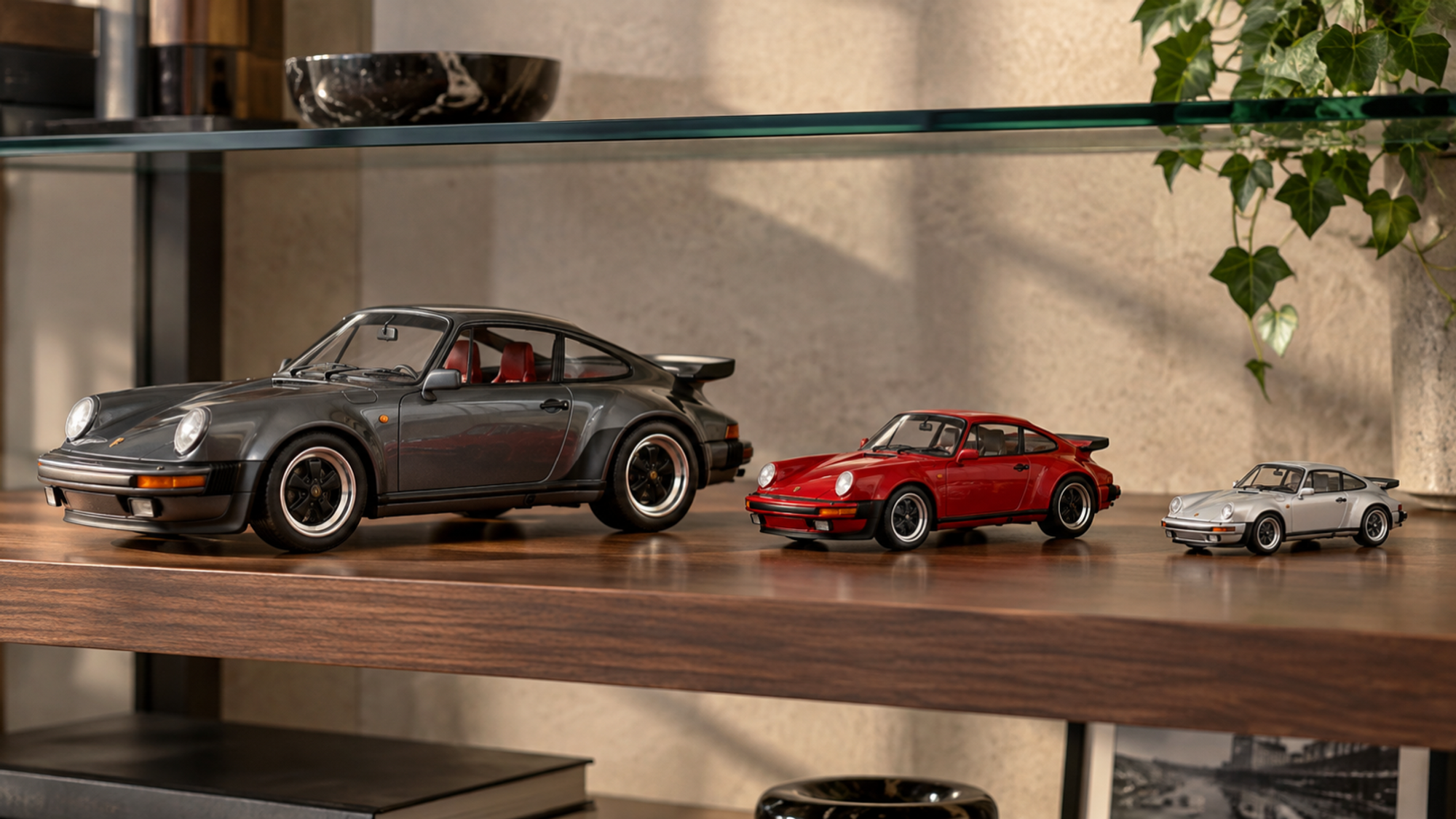
Scale sounds like a detail preference. It is not. It is a decision about how much of your home you are prepared to hand over, how many cars you will ever own, and how much of each one you will actually be able to see.
Get it right at the start and a collection grows comfortably for a decade. Get it wrong and you spend that decade quietly running out of room.
Here are the numbers first.
The table
<table header-row="true">
<tr>
<td>Scale</td>
<td>Typical length</td>
<td>Recommended display depth</td>
<td>Cars per metre of shelf</td>
</tr>
<tr>
<td>1:18</td>
<td>\~25 cm</td>
<td>28–32 cm</td>
<td>3</td>
</tr>
<tr>
<td>1:24</td>
<td>\~18 cm</td>
<td>22–25 cm</td>
<td>4–5</td>
</tr>
<tr>
<td>1:32</td>
<td>\~13.5 cm</td>
<td>16–18 cm</td>
<td>6</td>
</tr>
<tr>
<td>1:43</td>
<td>\~10.5 cm</td>
<td>12–15 cm</td>
<td>8</td>
</tr>
<tr>
<td>1:64</td>
<td>\~7 cm</td>
<td>9–11 cm</td>
<td>12</td>
</tr>
<tr>
<td>1:87</td>
<td>\~5 cm</td>
<td>7–9 cm</td>
<td>16</td>
</tr>
</table>
Sizes are approximate and vary with the subject — a 1:18 long-wheelbase saloon and a 1:18 Formula 1 car are not the same object. You can compare all six against each other, to scale, in our scale visualiser.
The "cars per metre" column is the one people ignore and then regret. It is also the column that should decide your scale.
What each scale is actually good at
1:18 — the hero scale
At around 25cm, a 1:18 model is large enough that the manufacturer can reproduce things that simply cannot exist at smaller sizes: functioning suspension geometry, separately-moulded brake calipers, seatbelt buckles, carbon weave that reads as weave rather than as a grey texture. On diecast examples, doors and bonnets open, and the mechanisms are real hinges rather than suggestions.
This is the scale that rewards being looked at closely. It is also the scale that demands a proper display depth — 28–32cm, which is deeper than most bookshelves — and gives you three cars per metre.
Buy 1:18 if you want to own a small number of models and know each one intimately. It is a scale for depth, not breadth.
1:24 — the awkward middle
Real presence, meaningfully smaller footprint, and a much narrower selection of subjects than either neighbour. Historically strong for American subjects and kits. If the specific car you want exists at 1:24 and nowhere else, buy it. Otherwise most collectors end up at 1:18 or 1:43.
1:43 — the collector's default
For decades this was the standard scale of serious collecting, and it remains the most sensibly proportioned answer to the space problem. At 10.5cm long and 12–15cm of display depth, a 1:43 model fits on a normal shelf in a normal home. You get eight per metre.
Crucially, 1:43 has the deepest catalogue of any scale. Obscure subjects, single-race liveries, complete championship-season sets — the things that make a collection interesting rather than just expensive — mostly exist here and often nowhere else.
Buy 1:43 if you want a collection with a narrative: a full season, a driver's career, an era. It is the scale for breadth.
1:64 — volume and trade
Roughly the size of a Hot Wheels car, and increasingly the home of genuinely premium models with real paint, rubber tyres and photo-etched details. Twelve per metre. Cheap enough to buy on impulse, small enough that a hundred of them fit in a cabinet.
The trade-off is honest: at 7cm, there is a hard ceiling on detail. Brake calipers become a painted suggestion. Interiors become an impression.
Buy 1:64 if you enjoy the hunt, the trading and the accumulation as much as the objects.
1:87 — the diorama scale
HO railway scale. You are buying it because you are building a scene, not because you want to look at the car.
The space arithmetic
Take the shelf or wall you actually have. Measure it. Multiply by the cars-per-metre column.
A 1.2m shelf holds either four 1:18 models or ten 1:43 models. That is the whole decision, stated plainly. Neither answer is wrong, but they are different hobbies, and it is better to choose than to discover.
Depth is the constraint people forget. A standard IKEA-type bookshelf is around 28cm deep, which accommodates 1:18 only just, with the model's nose at the shelf edge and nothing in front of it. Most wall-hung shelving is 20cm or less, which rules out 1:18 entirely.
Vertical clearance matters too: a 1:18 model needs roughly 12–14cm of headroom to be liftable off the shelf without tilting it, and tilting a model to get it out is how mirrors and wings break.
The money arithmetic
\[VERIFY: check all figures against current market prices before publishing — these bands move and dating them makes the article age badly. Consider stating them as ranges with a "as of 2026" note.\]
Broadly, in 2026:
- 1:64 — entry from a few pounds; premium and limited pieces run to £25–50.
- 1:43 — mainstream £40–90; high-end resin and limited runs £120–250.
- 1:24 — £50–150 depending on manufacturer.
- 1:18 — mainstream £80–200; collector-grade diecast with opening parts around £200–350; the very top of the market runs into the thousands.
Our own Almost Real 1:18 RUF models sit at \$249, which is representative of the collector-grade diecast band.
The useful way to think about this: at 1:43 you can build a twenty-car collection for the price of five or six good 1:18 models. Whether that is a better collection depends entirely on whether you would rather own more cars or know fewer of them better.
And add display cost. Whatever scale you choose, budget 20–30% on top for shelving, cases or frames. Almost every guide omits this and almost every collector discovers it.
Where detail stops being possible
A rough map of what survives at each size:
- Carbon weave as visible weave: 1:18 only.
- Separate brake calipers and disc detail: 1:18, sometimes 1:24.
- Functioning suspension: 1:18 predominantly.
- Legible dashboard instrumentation: 1:18, occasionally 1:24.
- Seatbelts as fabric with buckles: 1:18.
- Photo-etched badges and grilles: 1:18 through 1:43.
- Sponsor decals legible to the naked eye: down to 1:43; below that they become colour blocks.
None of this makes smaller scales lesser. A very good 1:43 model is a more difficult manufacturing achievement than an adequate 1:18 one. But if the reason you collect is to look closely, the scale decision is already made for you.
Mixing scales
It works when there is an obvious hierarchy: one 1:18 hero and a supporting cast at 1:43, clearly separated — different shelf, different zone, different lighting.
It fails when two scales sit adjacent at similar sizes. A 1:18 and a 1:24 side by side do not read as a deliberate contrast; they read as a mistake, because the eye assumes the two cars are different real-world sizes.
The rule: make the scale difference either obvious or invisible. Never adjacent.
Verdict by living situation
Small flat or shared space. 1:43. Eight per metre, fits a normal shelf, deepest catalogue. If you want one large piece, buy exactly one 1:18 and frame or case it as a focal object.
Family home with a dedicated wall. 1:18 for the cars that matter, 1:43 for the collection around them. Wall-mounted display for the 1:18 pieces recovers the floor space they would otherwise cost you — we have written about the reasoning.
Dedicated room. Whatever you like, but pick a primary scale and stick to it. A room of one scale reads as a collection. A room of four reads as a shop.
Desk or office. 1:43 or 1:64. A 1:18 model on a desk dominates the desk and eventually gets moved.
Before you buy
Go and look at the sizes at true scale rather than imagining them. Our scale visualiser shows all six against a common reference, which takes about thirty seconds and prevents the most expensive mistake in the hobby: buying a scale you cannot house.
Then, if you are starting from nothing, we have written a guide to building a first collection with a point of view.
See every scale at true size →